Collect
AI optionalWatch explicit pages and feeds, then archive everything new or only what matches.
Archived items
FlowReader Pro
Pro adds collection, signals, briefings, optional sync and archive-grounded AI. The local reader underneath stays exactly as it is.
01
Describe the outcome first. FlowReader runs it once, shows what happened, and only then offers to repeat it daily, weekly, or when new items arrive. One Flow can work from explicit watchlists, your own archive and open-web discovery, and can combine collection, tracked signals and cited briefings.
Describe what you want in ordinary language.
FlowReader plans it and runs it once, with visible steps.
Inspect the collected items, signal or cited briefing.
Only schedule the result after it proved useful.
Watch explicit pages and feeds, then archive everything new or only what matches.
Archived items
Follow a price, sentiment, mentions or another value over time and act when it changes.
Tracked value and alert
Research your archive, selected sources or the open web and write a grounded briefing.
Cited narrative and charts
Watch these five research blogs, archive every new post, and brief me on Friday.
Collect and Brief in one Flow.
Tell me when this price moves, and show the history in my next briefing.
Signal feeding a Brief.
What is trending on Hacker News today, and what are people arguing about?
One-shot discovery and cited research.
A Flow is not a configuration wizard with a save button at the end. You describe what you want in a sentence, FlowReader plans it and runs it once with its steps visible, and you read what came back. Only then are you offered the choice to repeat it — daily, weekly, or whenever new items arrive. A flow you never ask to repeat simply never runs again.
One sentence, planned and run in front of you. Placeholder.
Everything it decided, open for you to correct. Placeholder.
A briefing, with every citation checked against what the run fetched. Placeholder.
What each run did, step by step. Placeholder.
02
Sync is not a backup you hope never to need. It is what turns the browser extension, the desktop app, the phone and the machine at work into one library instead of four. Save an article on the laptop and it is on your phone on the train, at the paragraph you stopped on.
There are three ways to do it, and they are genuinely different arrangements rather than three brands of the same thing. One uses a FlowReader service. The other two use storage you already control, and encrypt the data with a passphrase only you hold.
The default. One device, nothing leaves it. No account, no server, no network dependency for reading.
Nothing is transmitted, so there is nothing in transit to protect.
The browser extension, the desktop app and the phone stay in step through FlowReader’s own service, in close to real time and without you doing anything. This is the one that makes a second device feel like the same library.
Protected by account authentication, TLS in transit, and per-user server rules that make one account’s data unreadable to another. It is not end-to-end encrypted: the service can technically read what it stores. If that matters to you, use folder or Dropbox sync instead.
Devices sync through your own Dropbox account. Slower to converge than Online Sync, and it needs Dropbox on each machine, but no FlowReader server is ever involved.
End-to-end encrypted with a passphrase you choose and only you hold: AES-256-GCM, keys derived with PBKDF2 at 600,000 iterations. Dropbox stores a file it cannot read. Lose the passphrase and the data is unrecoverable. That is what the guarantee costs.
Devices sync through a folder you control: an iCloud Drive or Google Drive folder, a network share, anything your own file-sync tool already handles.
The same end-to-end encryption as Dropbox sync, over whichever transport you chose. FlowReader never sees the folder or the passphrase.
03
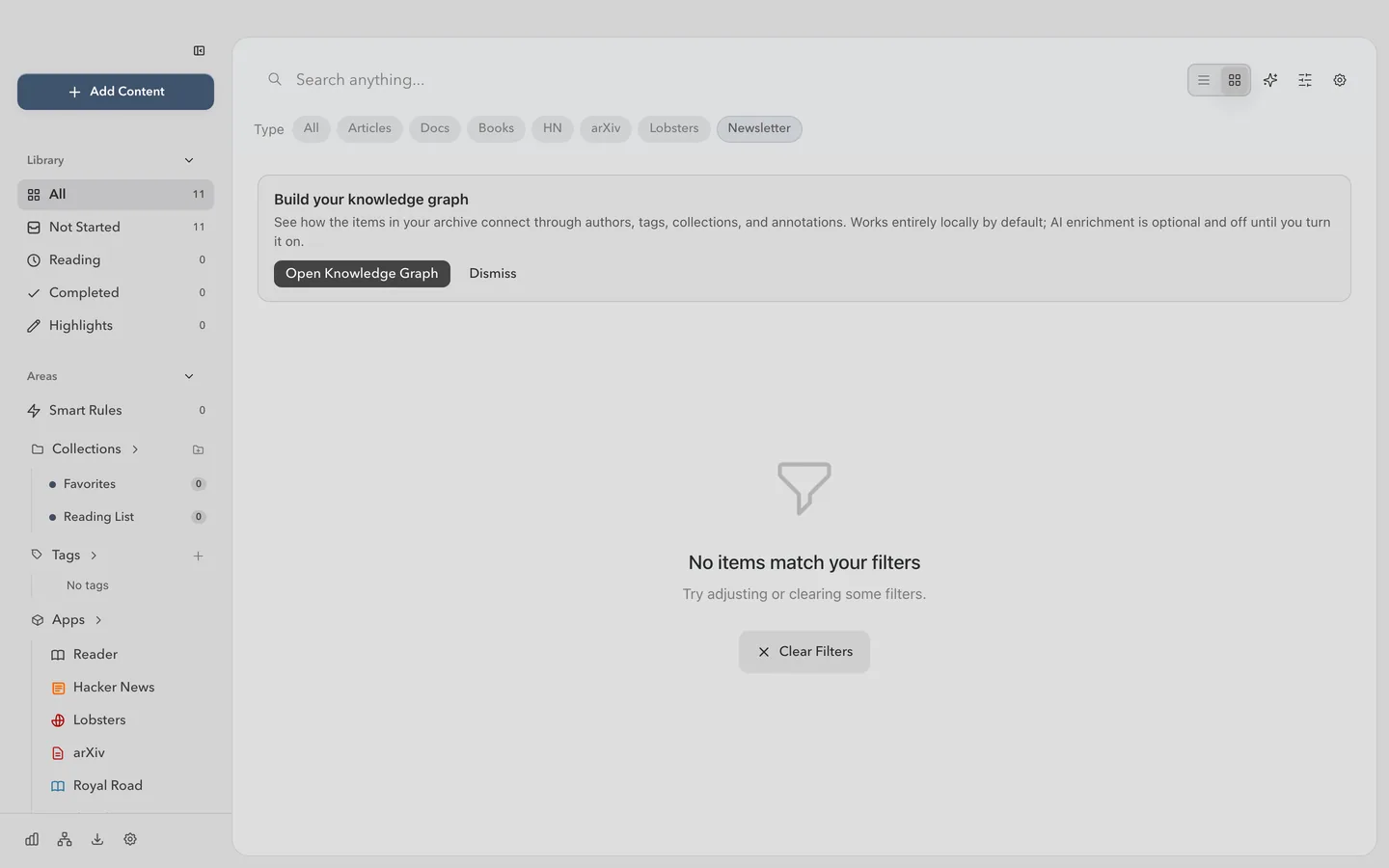
Generate private alias addresses and subscribe with them. Incoming newsletters are sanitized server-side and land in your archive as clean, readable items, with no inbox involved. Aliases can be disabled at any time, and senders can be blocked.
04
Persistent local automations that keep the library organized without manual filing. Condition trees combine nested AND/OR groups and negation across metadata, reading behaviour, and optional AI conditions; actions add to a collection, add a tag, or mark as read, and are always additive and idempotent.
05
A local graph across everything you save: items, collections, tags, annotations, extracted entities and the topics that emerge from them. It is built on your device from the archive you already have, and it finds the clusters you never named and the bridge items connecting otherwise separate areas of your reading.
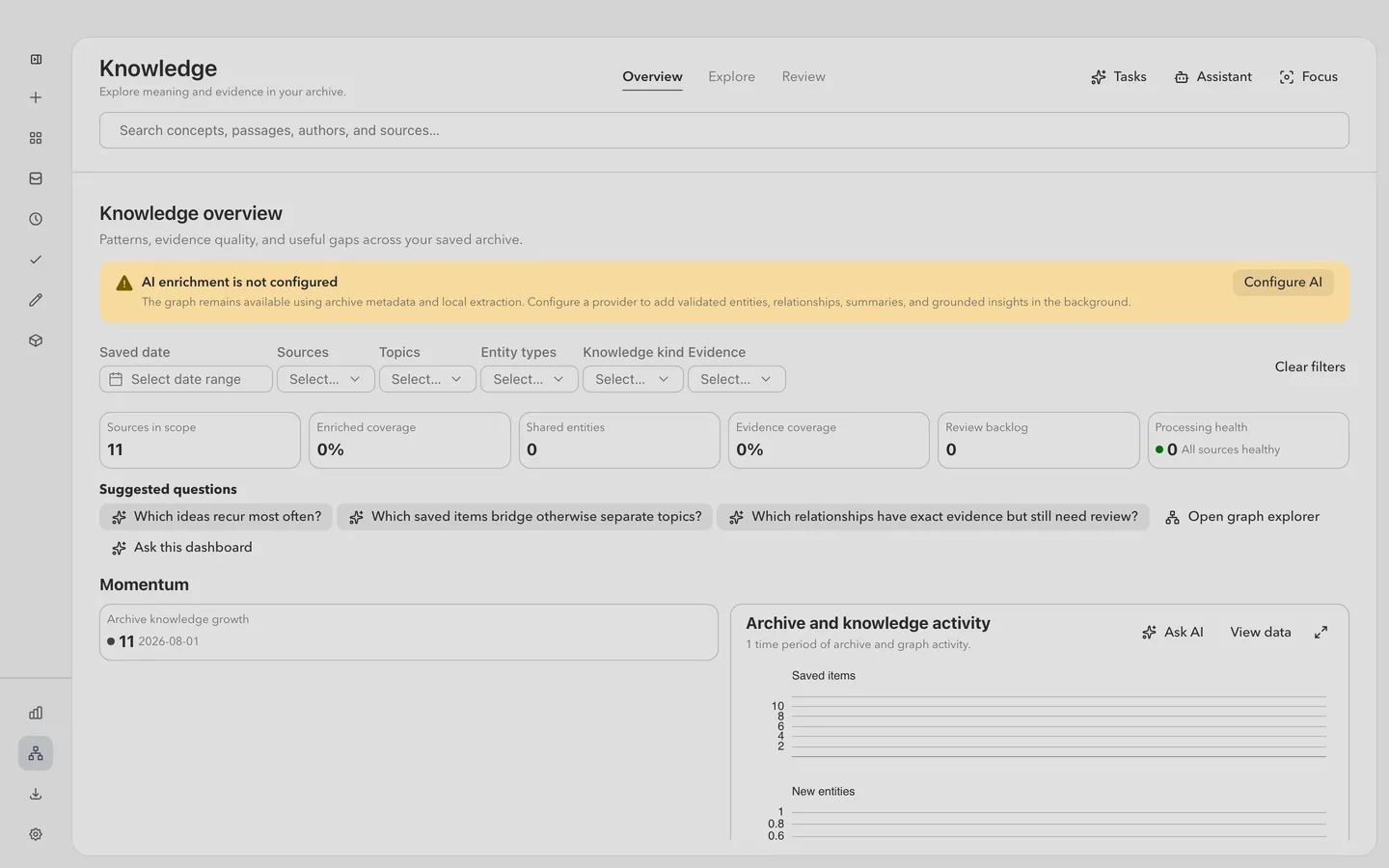
A graph over a small library is mostly noise: the structure needs volume before it means much.
06
Document chat and collection chat, with inline citations that jump back to the exact source passage. Tools cover archive search, opening items, reading the current page, web search and fetch behind per-origin consent, persistent memory, and the knowledge-graph toolset. Skills and sub-agents extend it; MCP servers bridge in external tools.
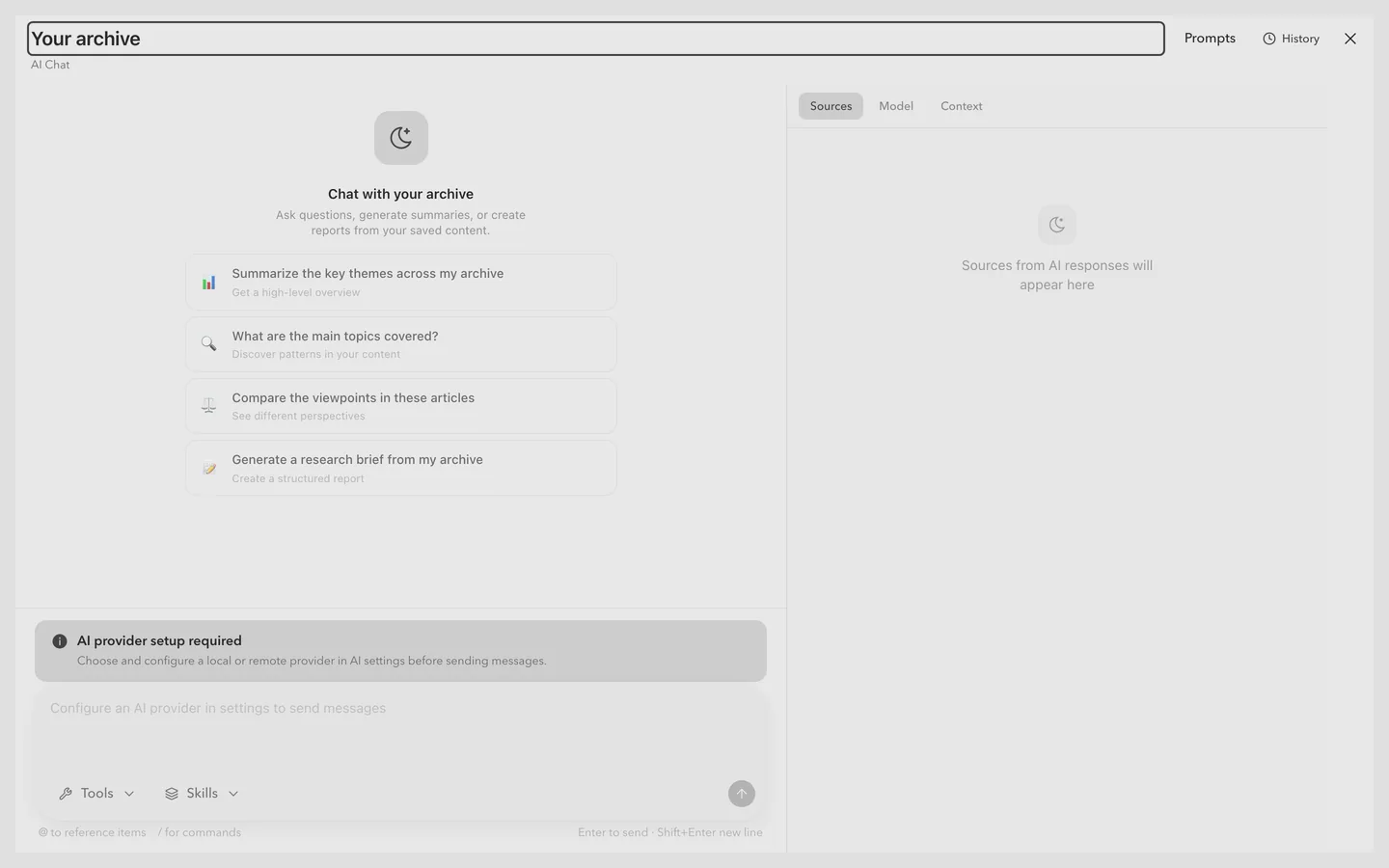
Routing covers Anthropic, OpenAI, Google and Hugging Face, or fully local models via Ollama and LM Studio. You supply the credentials. There is no app-owned AI key reading your data.
07
FlowReader runs a Model Context Protocol server, so you can authorize Claude — or any other client that speaks the protocol — to work with your library directly. Not a chat window bolted onto the app: your own assistant, searching what you have saved, filing it, highlighting a passage, saving a page you point it at, or starting a Flow and reading what it produced.
Connect over OAuth with PKCE. FlowReader never asks the client for your password, and you are shown the client and where it will send you back to before anything is granted.
https://mcp.flowreader.io/mcp
The consent screen lists one switch per permission the client requested. Reading is the floor and stays on; everything else is yours to refuse, which is how you give a client read-only access to your library. Fetching public pages is held apart from writing on purpose — letting something change your archive should not silently include letting it go out to the internet on your behalf.
ReadAlways on
Read your synced library, highlights, settings, history and accepted shares.
flowreader:data:read
Write
Save and change items, collections, tags, highlights, sources and automations.
flowreader:data:write
Delete
Delete items and organisation, and only after confirming each deletion.
flowreader:data:delete
Settings
Change reading, library, feed and AI preferences, themes and presets.
flowreader:settings:write
Shared archives
Contribute to archives other people have shared with you, where they allow it.
flowreader:shared:write
Fetch web pages
Fetch public web pages you ask it to read or save. Never private addresses.
flowreader:web:fetch
The boundary is architecture, not policy. The service reads your synced library through the same per-user rules the app does; it has no route to the device. A library you keep local, in Dropbox or in a folder is not withheld from a connected client — there is nothing there for it to reach. Provider keys and billing records are excluded outright, and credential-shaped fields are stripped in both directions.
Every connected client, what it may do, and one button to revoke it. Placeholder.
One switch per permission, approved before anything is granted. Placeholder.
Requires Pro, a verified account, and Online Sync switched on.
Deciding
It depends on whether your reading has to leave the device: a second machine, a mailbox, a server that keeps watching while the app is closed. Every difference is listed line by line on the pricing page, next to what it costs.
Get the desktop app or the browser extension.